Practice
Short drills that tell you exactly what to fix
Lessons show you how. Practice makes it stick: narrow drills scored the moment you lift the pen, a warm-up before you draw, and a skill check that shows how far you’ve come.
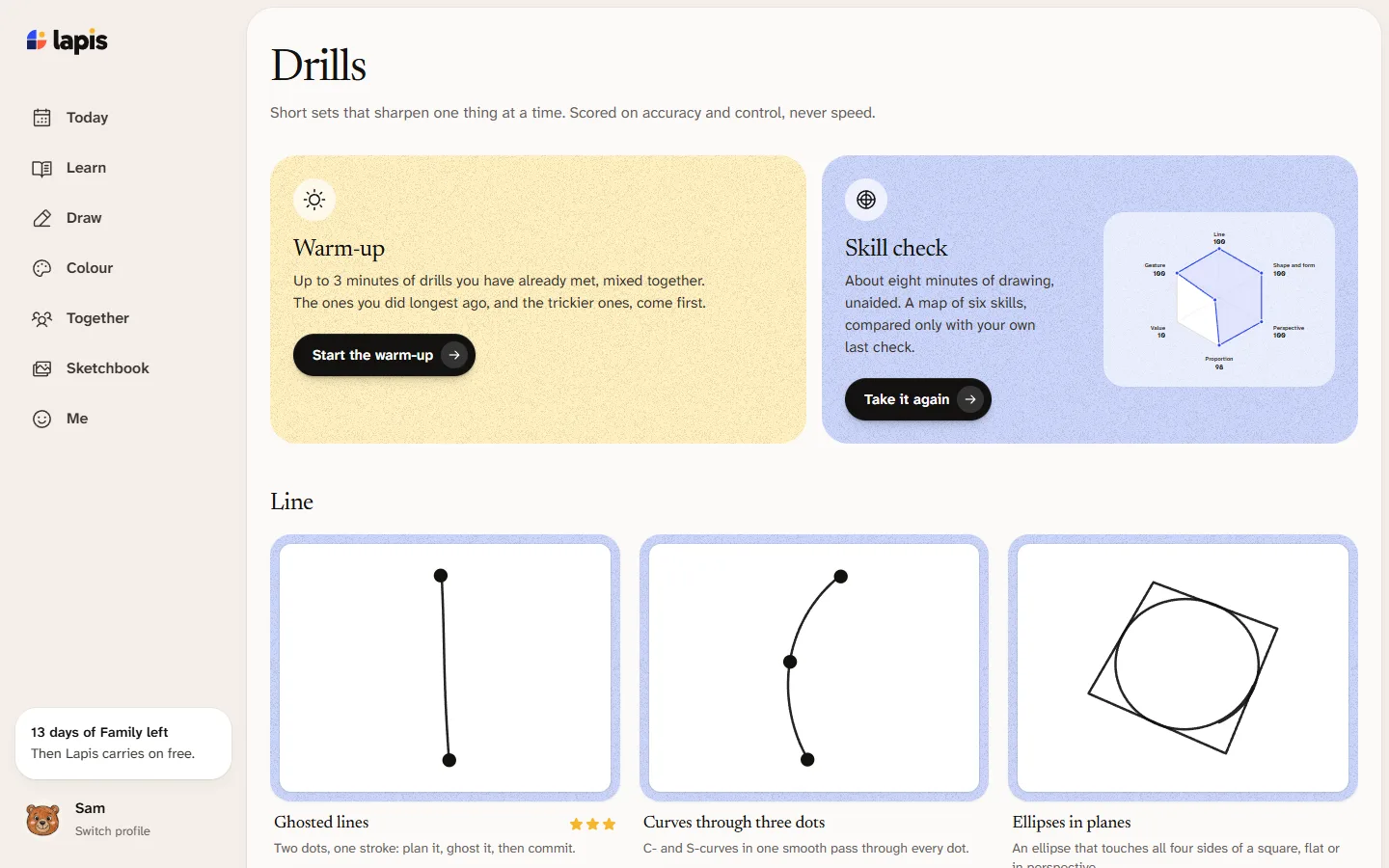
Drills
22 drills, each one a single technique
A drill is a short set of 10 to 30 items that change every time, getting harder as you improve. Each one is scored as soon as you draw it, with feedback about the drawing: the far end landed a little short, this ellipse is too open.
- Accuracy and control, never speed
- Feedback you can act on in the next stroke
- A trend over weeks, not a verdict on a day
For 13 and up
The drills for teens and grown-ups
15 drills across line, perspective, value, proportion, observation and gesture.
- Line
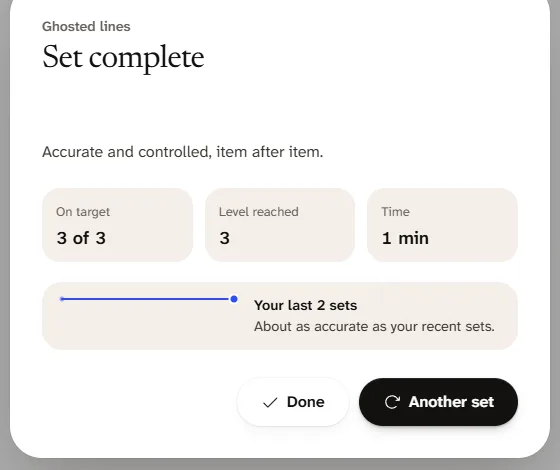
Ghosted lines
Two dots, one stroke: plan it, ghost it, then commit.
15 items. Measures: deviation from straight, landing on the end dot, one stroke.
- Line
Curves through three dots
C- and S-curves in one smooth pass through every dot.
12 items. Measures: deviation from the ideal curve, reaching each dot, smoothness.
- Line
Ellipses in planes
An ellipse that touches all four sides of a square, flat or in perspective.
10 items. Measures: touching all four sides, closure, degree.
- Line
Ellipse tables
Ellipses of a set degree on a minor axis, drawn through two or three times.
12 items. Measures: degree error, axis error, how tightly the loops sit.
- Perspective
Ghosted planes
Four edges, two diagonals and an inscribed ellipse on a plane in perspective.
8 items. Measures: edges landing on corners, diagonals meeting at the centre, the ellipse.
- Perspective
One-point boxes
Boxes above, on and below the horizon, every receding edge to one point.
8 items. Measures: convergence error, parallel verticals and horizontals.
- Perspective
Two-point boxes
A box from its nearest edge, each set of edges to its own vanishing point.
6 items. Measures: convergence error for each set of edges, upright verticals.
- Value and light
Value scale
Five or nine steps from paper white to your darkest dark, in even jumps.
4 items. Measures: evenness of the steps, the full range, the order.
- Value and light
Value match
Fill a square to match a target grey.
8 items. Measures: difference from the target value, evenness.
- Proportion and measurement
Angle match
Match an angle against true vertical and horizontal.
15 items. Measures: angle error in degrees.
- Proportion and measurement
Shape copy
Copy a shape at a given width and keep its proportions.
10 items. Measures: shape match after scaling, ratio error, corner placement.
- Observation
Segment copy
Copy a line drawing one short segment at a time, looking back after each.
8 items. Measures: overlay error, corner placement, drawing segment by segment.
- Proportion and measurement
Landmarks
Mark where the eyes, the hips and the knees go on heads and figures.
10 items. Measures: landmark placement error as a share of the height.
- Observation
Memory drawing
Study a drawing for thirty seconds, then draw it from memory.
6 items. Measures: overlay of the memory drawing, the parts remembered.
- Gesture
Line of action
One sweeping curve that carries a pose, from the head to the foot.
12 items. Measures: angle and curve against the pose’s own line.
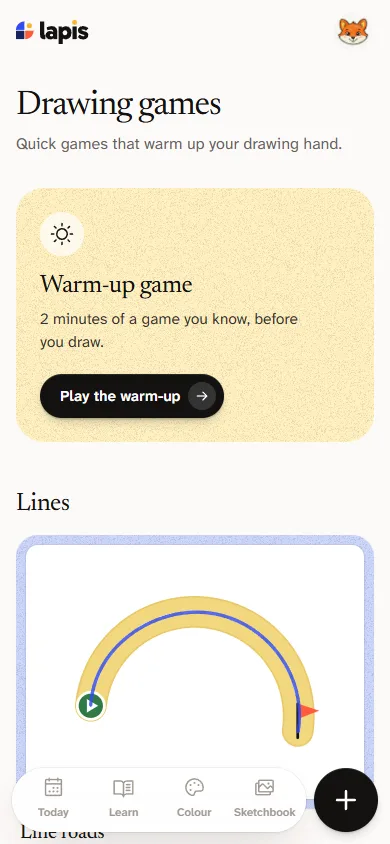
For children
For children, drills are drawing games
7 games for little hands, with wide tolerances and nothing scored on screen. Children hear what they did (“you kept the line on the road”), never a mark. How their lines are coming along goes to the grown-ups’ report, in plain words.
- Line roads Drive a crayon along the road, from the car to the flag.
- Dot-to-dot Join the dots in order and a picture appears.
- Snail trails Follow the snail’s wavy, loopy, curly trail.
- Shape frames Go round inside a frame, then fill it with strokes that stop at the edge.
- Mirror halves Finish the other half of a flower, a bug or a face.
- Memory peek A shape peeks out, hides, and you draw it from memory.
- Hidden shapes Find the circle, square or triangle hiding in a picture and draw round it.
Warm-up
A warm-up before you draw
Before you draw, Lapis offers a warm-up made from drills you’ve already met. For teens and grown-ups it mixes them and favours the older and weaker ones, because mixed, spaced practice is remembered better, even if it feels harder. For children it’s one game at a time, and two minutes at most.
- Ten minutes for 13 and up Two minutes for children.
- Mixed for older learners Different drills, favouring what you met longest ago.
- Then you draw A warm-up is never the whole session: the canvas is one tap away.
Skill check
A skill check that compares you with you
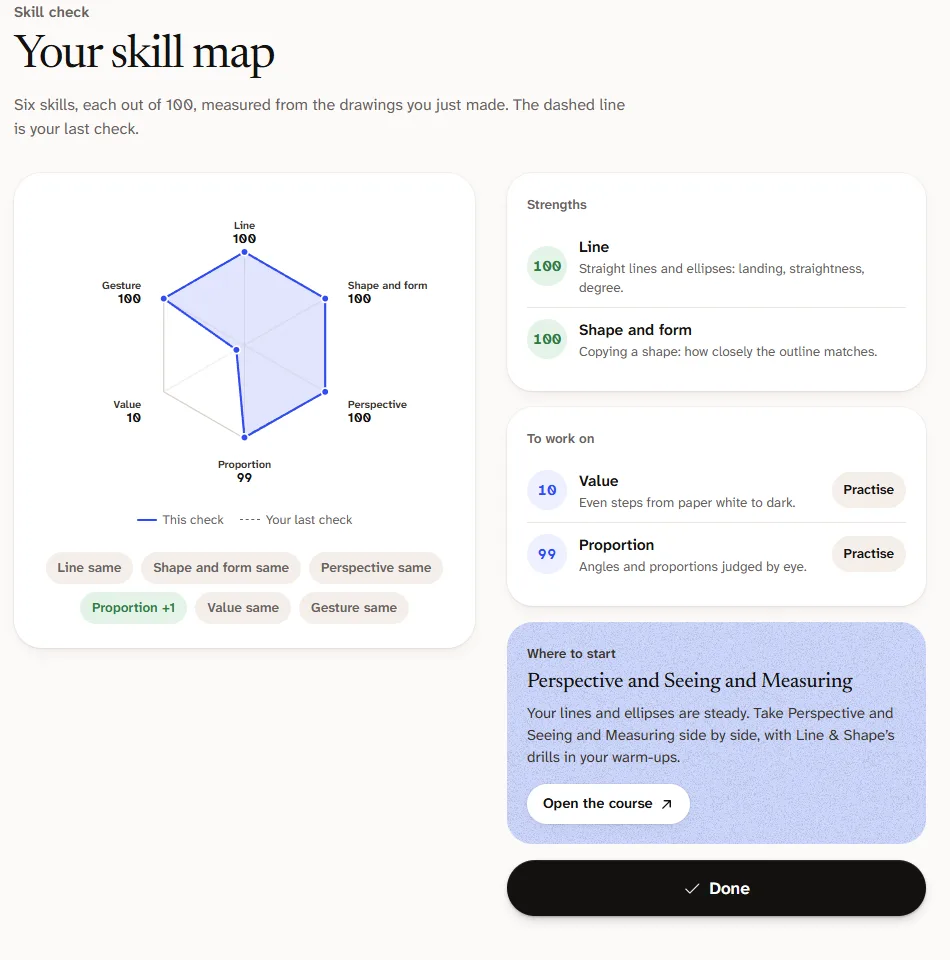
About eight minutes of drawing, unaided, gives teens and grown-ups a map of six skills. Take it again in a few months and the dashed line shows where you were. It suggests where to start; it never locks anything.
- Line
- Shape and form
- Perspective
- Proportion
- Value
- Gesture
- No percentiles, no leaderboards, no speed scores
- Under 13? Nothing is scored on screen: a then drawing and a now drawing instead
Warm up, then draw
Make a free family account and try your first drill in a couple of minutes, with a finger, a mouse or a pen.